
In what can only be called a remarkable feat is the launch into space – and re-entry – to Earth of 12 DJI Osmo Action 6 cameras. DJI’s full ecosystem of imaging devices, including an upcoming Osmo 360 II was used to establish an on-site filming network spanning from the sky to the ground.
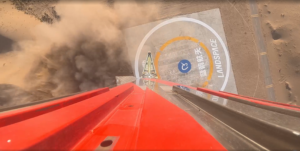
During the successful launch and recovery of the reusable Zhuque-3 rocket by LandSpace, a privately owned commercial aerospace company, twelve DJI Osmo Action 6 cameras were mounted on the first-stage rocket body. This milestone marks the first time that a consumer-grade action camera has been used as a recording device for a space rocket’s launch and recovery – without any special modifications. Not only did the Osmo Action 6 withstand extreme 500°C operating conditions to leave and return to Earth, but it also brought back extraordinarily valuable first-person footage – from ignition and liftoff, through the journey across the atmosphere, to landing and recovery.
Osmo Action 6 Launched Into Space Without Modifications
The Osmo Action 6 cameras were fixed at different critical positions on the first-stage rocket body, using a first-person perspective to document the entire launch and recovery process. The footage delivered a completely different view from previous one-way, space-perspective recordings. For the commercial spaceflight industry, where reusability is a key way to reduce costs, the high-fidelity native footage will help aerospace engineers review the recovery process, assess the rocket’s first-stage body condition, and replicate successes.
Osmo Action 6 Survives Extreme Conditions in Space
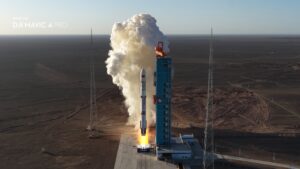
Capturing this footage presented extraordinary challenges. During both ascent and return, aerodynamic heating raises the rocket body’s surface temperature to roughly 400°C–500°C, while the engine and flight generate continuous high-frequency, high-intensity vibration. Even more challenging, passing through the atmosphere involves the “blackout zone” that causes a complete loss of external communication. Facing these extreme conditions, the DJI Osmo Action 6 demonstrated astonishing ruggedness for a mass-produced consumer camera. Not only did it “survive” thanks to its integrated high-strength structure, but its onboard direct-recording capability also overcame the communication limitations of the “blackout zone,” ensuring all high-definition data returned to the ground completely intact.
Osmo Action 6 Captures Steady, Clean Footage
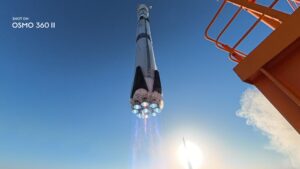
The Osmo Action 6’s new-generation, ultra-powerful stabilisation algorithm made it possible to “shoot steady,” filtering out the image shake caused by the rocket body’s high-frequency vibration without over-cropping the frame. Even during the launch’s high g-loads and large maneuvers during first-stage attitude adjustments, the Osmo Action 6 delivered smooth and coherent footage while faithfully reproducing the details and attitude changes of the rocket’s flight. It was also able to “shoot clear” in the extremely complex lighting conditions of space – a testament to its strength. Equipped with a 1/1.1-inch custom square large-format sensor, supporting recording of up to 4K/120fps and 13.5 stops of high dynamic range, the camera was able to adapt to the complex lighting environment in space – from intense high-altitude sunlight, low-altitude backlighting, and sand and dust. The resulting footage preserved the rich highlight and shadow details, while clearly capturing key high-speed moments such as the engine’s ignition, grid-fin attitude adjustment, and landing cushioning.
DJI Cameras (including upcoming Osmo 360 II) Film the Launch Closely On-site
Beyond the rocket-mounted first-person perspective, DJI’s full ecosystem of imaging devices was used to create an on-site filming network spanning from the sky to the ground. This included the DJI Mavic 4 Pro for aerial photography, DJI Matrice 4TD for thermal imaging, Osmo 360 II for panoramic 360° imaging and Osmo Pocket 4P for cinematic-quality footage. Together, these DJI products provided high-altitude situational tracking and thermal-imaging monitoring as well as behind-the-scenes footage on the ground. With multiple, blind-spot-free perspectives, they documented this moment in aerospace history.
Below is 9 minutes long but it is very, very impressive.
This is shot from a DJI OSMO 360 II of the launch itself.