
Back in the day, as they say, when computers first started appearing on desks making you a “have”, in order to sort of show your technical superiority over those who were “have nots” (no computer), the buzzword generator was invented.
It was a simple device letting you throw random techie words together to make what sound like a highly technical term that only you understood.
An example might be “scalable, multi-centric ecosystem”. Or perhaps “adaptive data architecture”.
I mention this, because many times vendors use the term AI – “artificial intelligence” used in their products or services. It is often garbage, and what they are actually saying is that highly complex mathematical computations have taken place to get a result. Yep. It’s just a buzzword / phrase most of the time.
As such, I commend DJI, as I cannot find a single reference to the term ‘AI’ in a quick search of its blurb on the RS5 Ronin gimbal released in late January, instead referring to “Intelligent Tracking”.
So, what is the RS5, who is it for and what is this “intelligent tracking” guff all about?
Birth of the Gimbal
Roughly at the beginning of the decade, the demise of the camcorder and resultant uptake of the dSLR / Mirrorless body style camera for video shooting, meant that a decent means of stabilising the camera was needed.
Simply, the body style and ergonomics of these sorts of cameras is not conducive to stable imagery (as against a true camcorder).
And so, the commercial / consumer gimbal was invented. Initially, every man and his dog was making them, but eventually there was a shake down and out of the resultant dust remained Feiyutech, Zhiyun and of course, the daddy of them all, DJI.
Currently, a 4th supplier, MOZA is popular but hard to find in Australia, and Feiyutech is occasionally available from places like JB HiFi and HN. In short though, DJI rules the roost with Zhiyun, which a few years back was very popular, a distant second.
Basically, there are three classes of gimbal; the first designed for smartphones, the second for mid-size cameras like the Sony alphas or LUMIX G series, and thirdly, gimbals for bigger bodied cameras such as the larger Canon R series.
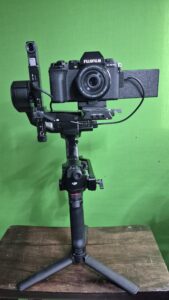
The DJI RS5 is described as a “lightweight commercial gimbal” and as such, is aimed at users of cameras such as the Nikon Z8, Pana GH7, Canon EOS R8, Sony A7, or in my case, the Fujifilm X-S10.
Evolved Features
Over the years DJI has added some small touches as its gimbals have evolved, and the RS5 shows a number of these, making it easier to use and importantly, as this is crucial to its optimum operation, easier to get balanced with the camera attached.
Gimbals work on a 3-way axis system; roll, pitch and yaw. It is necessary to have these perfectly balanced with the camera, and in the past, sliding each of the arms to maintain that could be a real pain due to friction. Cleverly, DJI has incorporated a series of fine-tuning knobs on Teflon runners for each axis making it much smoother and easier.
Tip: When balancing, make sure the camera is in the “mode” it will be for the actual shoot. For example, if you shoot with the LED screen open, balance it with the camera setup that way. Ditto the addition of mics, and each lens type will need a new balance.
A great idea for both ergonomics and control is the addition of the briefcase handle. It’s an optional extra in the base unit for $85.
The briefcase handle allows a two-handed approach to holding the gimbal and camera and adds extra controls at the top to stop / start shooting, directional control and more. Additionally, an open RSA port on the briefcase handle is available for 3rd party developers to create custom functions.
One other thing; DJI has redesigned the mounting system in order to make it quick and easy to change the camera orientation from horizontal to vertical, and it also supports the optional focus pro motor and SDR transmission systems.
When you have finished shooting and turn the DJI RS5 off, it automatically locks the three arms, eliminating the need for a re-balance if the same camera setup is used.
Battery life has also been increased with a 30 hours standby time and 14 hours shooting time.
Intelligent Tracking
OK, after all that preamble, lets discuss the intelligent tracking. It is an optional extra for the base unit but for the $125 or so dollars, adds an entire new dimension to your shooting.
The module itself is a compact, magnetic attachment, about the size of a matchbox that allows intelligent real time tracking of objects. You can see it in the image at the top leftof the gimbal . It actually integrates with the gimbal’s own active tracking system and keeps people, pets andjust about any moving object in the centre of the frame once you have selected it.
DJI says it can be used successfully whether you are using the gimbal to capture orbit or running shots, backward tracking and even live streaming. It is easy to switch between the different follow modes on the gimbal when using the intelligent tracker by simply sliding the switch from Pan, Follow, to Pan, Tilt, Follow.
The speed of the follow can be adjusted too, from slow to medium to fast.
With the tracking module, you select your subject on the gimbal’s touchscreen to start the tracking process.
The module will itself select any possible ejects, and you can switch between multiple detected objects using the rotary ring on the gimbal. Alternatively, you can draw a bounding box around the desired subject on the LCD screen of the gimbal.
Gesture triggers such as start/stop tracking, adjust composition etc are also supported. For selfie shot tracking, you can rotate the camera and tracking module. An LED ring on the module shows different colours dependent on its status such as active, lost subject, sleep mode etc.
The tracking module is rechargeable via USB-C and uses the RSA port to connect to the gimbal.
I found the tracking module one of those little things that actually give a very big enhancement, so would recommend anyone getting the DJI RS5 gimbal to add this accessory. There is also an adaptor available for existing users of the RS4 gimbal.
Conclusion
The DJI RS5 gimbal retails for $839 or with the brief case handle and the tracking module, $999.
PS: Trap for new players. On the left-hand side of the DJI RS5 is a small switch that switches the joystick from normal joystick mode to zoom mode. If you have the briefcase handle attached , it slightly covers this switch potentially, and you may not notice it has changed position making you wonder why suddenly you have no joystick control!
I’ll have video showing the unit in action shortly